
-
About
- Friday, May 17, 6 p.m.
- Saturday, May 18, 11 a.m.
Commencement
Celebrating the Class of 2024
About
-
Academics
- Friday, May 17, 6 p.m.
- Saturday, May 18, 11 a.m.
Commencement
Celebrating the Class of 2024
Academics
-
Admission & Financial Aid
- Friday, May 17, 6 p.m.
- Saturday, May 18, 11 a.m.
Commencement
Celebrating the Class of 2024
Admission & Financial Aid
-
Student Life
- Friday, May 17, 6 p.m.
- Saturday, May 18, 11 a.m.
Commencement
Celebrating the Class of 2024
Student Life
- Athletics

An image of a letter being caught by a fishing pole with the text "Gone Phishing"
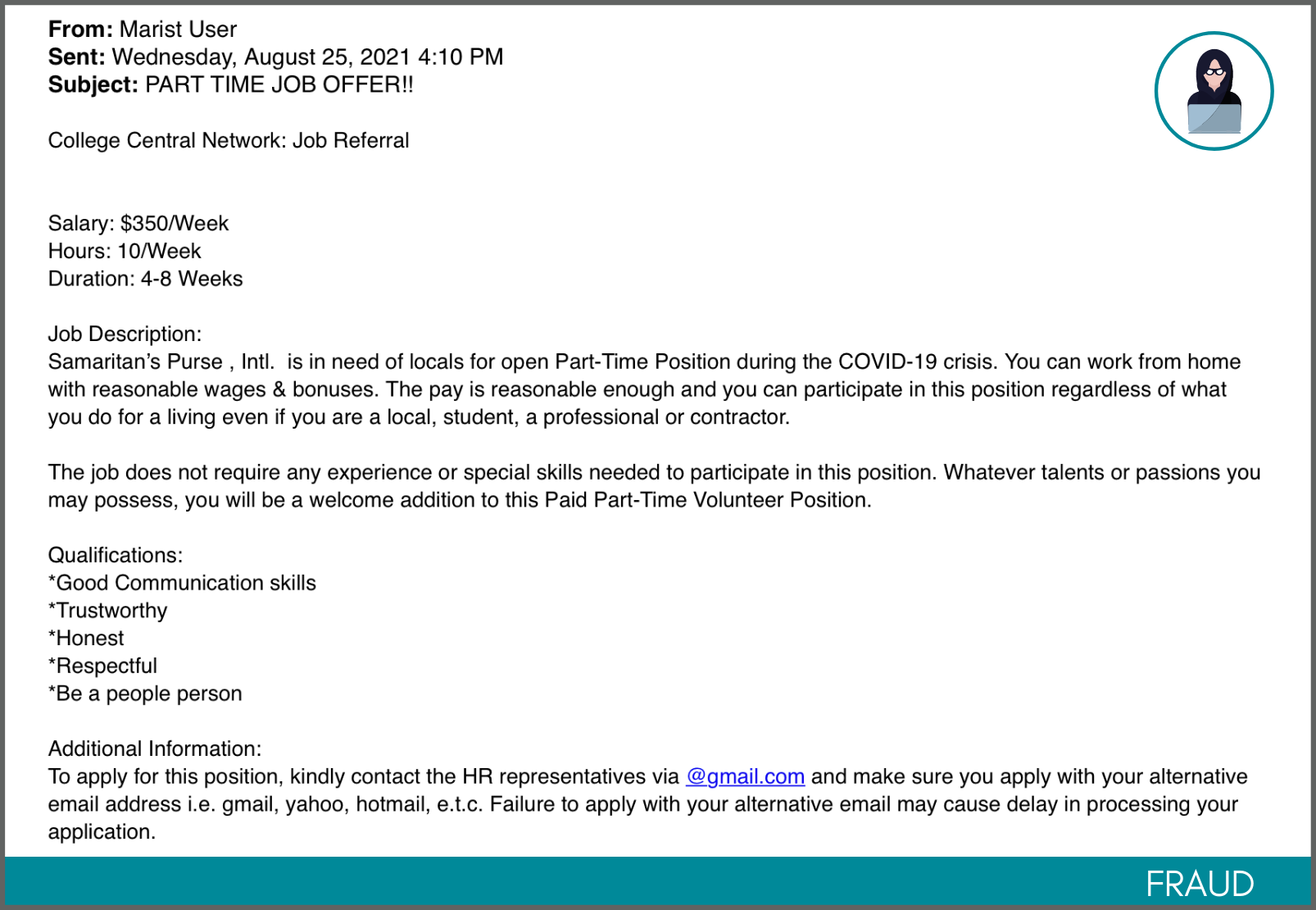
Why this looks valid
- Unsolicited job offers directed at college students are common
Why this is fraud
Awkward grammar and sentence construction are good indicators of malicious emails
Responding to this email leads to the collection of personal information
Additional interaction with the sender leads to a check fraud scam
Additional notes
Did you catch the last paragraph? They insist that people apply to this job using a non-Marist address. They want to ensure future communications take place completely outside of Marist College services.
Are you a Marist student looking for a job? Contact the right experts who can help you at the Center for Career Services: https://www.marist.edu/academic-resources/career-services
Fraudulent job offers are extremely common. For more information, see https://www.bbb.org/article/news-releases/20710-scam-alert-employment-scams-target-college-students
The FTC has additional information about how these scams work. The sender will mail a check and ask the recipient to send back the difference in the service cost through a wire transfer. The check will be fraudulent, but by the time your bank figures it out you will be out a few hundred (or thousand!) dollars and it is likely those funds will never be recovered: https://www.consumer.ftc.gov/articles/job-scams
A little paranoia goes a long way! Be suspicious of any email messages similar to this one.