
-
About
Marist Fall 2026 Open House
Join us for our final Fall Open House and see Marist for yourself. Explore our stunning riverfront campus, learn more about academics and admissions, and get a firsthand look at life as a Red Fox. Along the way, you'll hear from students, faculty, and staff about the opportunities, connections, and experiences that make Marist special. Register Below:
About
-
Academics
Marist Fall 2026 Open House
Join us for our final Fall Open House and see Marist for yourself. Explore our stunning riverfront campus, learn more about academics and admissions, and get a firsthand look at life as a Red Fox. Along the way, you'll hear from students, faculty, and staff about the opportunities, connections, and experiences that make Marist special. Register Below:
Academics
-
Admission & Financial Aid
Marist Fall 2026 Open House
Join us for our final Fall Open House and see Marist for yourself. Explore our stunning riverfront campus, learn more about academics and admissions, and get a firsthand look at life as a Red Fox. Along the way, you'll hear from students, faculty, and staff about the opportunities, connections, and experiences that make Marist special. Register Below:
Admission & Financial Aid
-
Student Life
Marist Fall 2026 Open House
Join us for our final Fall Open House and see Marist for yourself. Explore our stunning riverfront campus, learn more about academics and admissions, and get a firsthand look at life as a Red Fox. Along the way, you'll hear from students, faculty, and staff about the opportunities, connections, and experiences that make Marist special. Register Below:
Student Life
- Athletics



Marist + AI
Marist University's Framework for AI Leadership

Marist University's AI strategy is built on the belief that technology should advance human values, not replace them. We follow an “and” not “or” philosophy that blends intellect, character, and ethical reflection with technical skills and applied learning. In this way, we prepare individuals to lead responsibly in an AI-driven world as ethically intelligent leaders.
Marist’s vision for AI represents a three-year strategic roadmap developed through cross-divisional collaboration. This vision emerged from the work of the Marist + AI Steering Committee, a body comprised of faculty, staff, and student representatives from across the University.
The development process incorporated multiple channels for community input including open forums and facilitated discussions, along with benchmarking of peer and aspirant institutions. This inclusive approach ensures the vision reflects the diverse perspectives and needs of the Marist community while maintaining alignment with the University’s mission and the strategic priorities established in Marist 100.
Given the rapid evolution of AI technologies, the AI Committee will conduct annual reviews of this vision to assess progress, evaluate emerging opportunities and challenges, and adjust priorities as needed. This adaptive approach ensures that Marist remains responsive to technological change while staying true to our commitment to human-centered innovation.
The Six Principles for Marist + AI
We will ensure meaningful human oversight so that AI technologies support Marist's mission without replacing the critical human elements of decision-making. We will maintain the highest standards of integrity, particularly as we integrate AI tools into teaching and learning. Our goal is to deploy AI solutions that empower people, enhance their abilities, and maintain their autonomy.
We will prioritize transparency, accountability, and fairness in AI initiatives. This commitment includes making the role and usage of AI clear to our community and establishing frameworks that hold us accountable for AI outcomes. We will actively work to ensure that AI is used in a fair, transparent, and secure manner that respects privacy. We are dedicated to upholding the highest standards of academic integrity by defining ethical guidelines for AI use in academic work.
We will facilitate equity, collaboration, and education in AI initiatives. This commitment includes evaluating the broader social implications of AI and fostering positive contributions to both our community and global society. We will actively work to prevent AI from exacerbating existing inequalities through comprehensive education about algorithmic bias, data privacy, and labor impacts. We are dedicated to developing a critical and responsible approach to AI by establishing clear frameworks for its implementation.
We recognize the importance of environmental sustainability and responsible stewardship of resources in the deployment of AI. We commit to collaborating with individuals, offices, and committees to understand, assess, and guide actions that minimize AI's environmental impact. We will be mindful of the environmental impact associated with AI technologies and collaborate with partners who share our commitment to sustainability.
We will facilitate equitable access to AI tools and serve as a resource through our institutional initiative to design responses to AI. We will work to bridge the digital divide by providing targeted support to those who need it. Our goal is to make AI a force for inclusion and opportunity for everyone in our community.
We will foster an informed and engaged community regarding AI. We will promote AI literacy to ensure that our students, faculty, and staff understand and are prepared to use AI responsibly in the classroom and the workplace. Additionally, we will create opportunities for open dialogue about AI's role and impact, allowing for continued conversations and contributions to our approach and to help adapt our guidelines as technology and community needs evolve.
How is Marist using AI?
From President Kevin Weinman
AI is reshaping the way we teach, the way we learn, and the way we work, and no member of our community is untouched by its influence. Marist is uniquely positioned to prepare its students not just to succeed but to lead and thrive in a world where AI and its opportunities and threats continue to proliferate.

Three Pillars of AI Ethical Intelligence

AI Readiness
- AI Readiness Plans
- Curriculum Integration
- Faculty and Staff Development
- Operational Effectiveness

AI Literacy
- Marist AI Academy
- Credentialed Opportunities
- AI-Enhanced Student Success
- Informal Engagement

Ethical AI Innovation
- Experimentation
- AI Discovery and Adoption
- Strategic Collaboration
- Thought Leadership
- Alumni Engagement
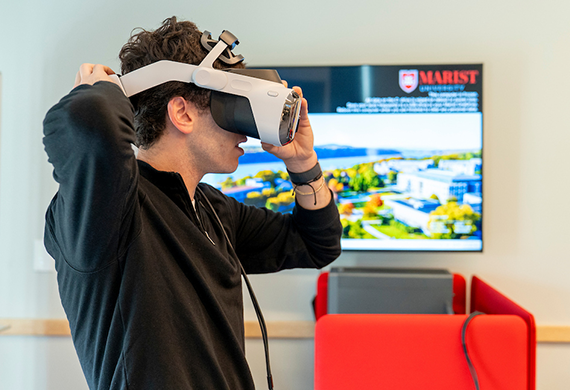
Marist Named as one of the Best for AI Preparedness
Marist University was named in Town & Country magazine's “15 Colleges Best Preparing Students for the AI Economy.” The recognition highlights Marist's distinctive “and, not or” academic approach—combining rigorous AI and technical training with ethical reflection, interdisciplinary learning, and real-world application. The list focused on schools that thoughtfully integrate AI across diverse areas, disciplines, and curricular pathways; focus on hands-on access and real-world application to ensure competency within and beyond technology; and demonstrate leadership in AI ethics, governance, and societal impact.
Read More About Marist's Ranking >
Learn How Marist is Preparing Every Student to be AI-Ready >

Marist University and IBM Launch Innovation Incubator with IBM z17
Marist University and IBM are advancing their longstanding partnership by launching the Marist-IBM Innovation Incubator, designed to accelerate AI research, experiential learning, and workforce development. Equipped with an IBM z17 mainframe, the incubator will support collaborative projects in business, finance, civic engagement, and beyond, while giving students direct exposure to enterprise-scale technology. The initiative reflects a shared commitment to preparing the next generation of graduates for success in the AI-driven economy.
Read Marist University's Framework for AI Leadership
Marist University Framework for AI Leadership

The liberal arts have always prepared students to navigate ambiguity, exercise moral judgment, and lead with empathy and conviction. AI makes these skills more valuable, not less. At Marist we are leveraging the humanities for a better future."

Kevin Gaugler
Professor, Spanish, Assistant Dean, School of Liberal Arts
Co-Chair, AI Steering Committee
What excites me most about this vision is that it came from our community and reflects something Marist has always known: that people and purpose come before everything else. This is Marist embracing what's new without losing sight of what matters most."
Diane Hart
Associate Vice President, Special Projects and Innovation
Co-Chair, AI Steering Committee
AI in the Classroom: Faculty Perspectives and Practices

Eitel J.M. Lauría
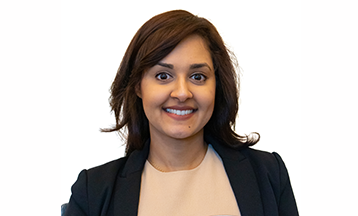
Shanaaz Mohammed

AI in the Classroom: Faculty Perspectives and Practices
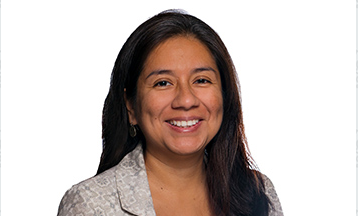
Gissella Bejarano
Shanaaz Mohammed
Upcoming Events

CONTACT: AI Steering Committee


