

Marist Nurtures Relationships with Local Community Through New Writing with Nonprofits Class
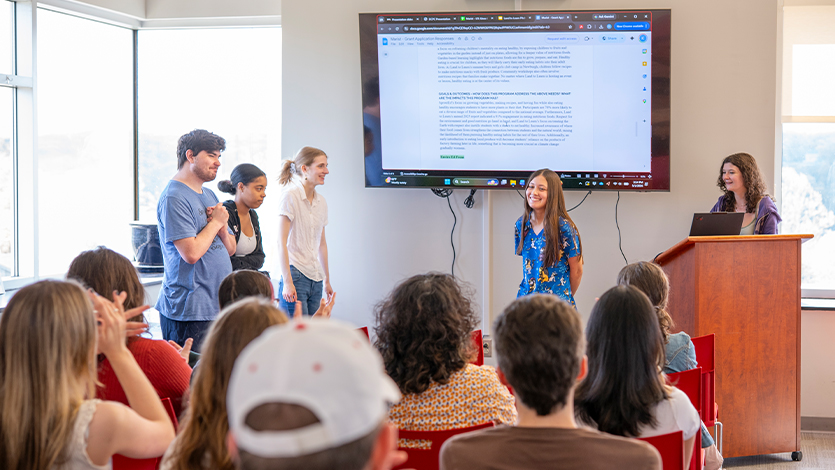
Students receive feedback from Land to Learn on their project. Photo by Benson Delaney ‘27/Marist University.
May 12, 2026 — Marist expanded its Hudson Valley community partnership work this semester with Writing with Nonprofits, a new English course connecting students directly with local organizations. Created by Dr. Catherine Chaterdon, the special topics course quickly filled as students jumped at the chance to support nonprofits through purposeful writing and hands-on community work.
The class partnered with three Hudson Valley nonprofit organizations: Land to Learn, Casa Comunitaria De Recursos (CCDR), and Dutchess County Pride Center (DCPC). With the help of the Center for Civic Engagement and Leadership, it continued Marist’s longstanding partnerships with CCDR and DCPC and fostered a new one with Land to Learn.
Cultivating Gardens and Relationships: Land to Learn
Left photo: (from L-R) Tori Hegenauer ’27, Kiki Wiehe ’26, and Tazaliyah Barnes ’28 at an Earth Day Event. Right photo: Jenna Labadessa ’28 (left) and Luke Feury ’26 (right) interact with kids during a garden lesson. Photos courtesy of Land to Learn.
Land to Learn cultivates connection to food, land, and community by engaging youth in hands-on, garden-based education that nourishes health, ecological awareness, and collective well-being.
Working closely with Nicole Porto, Executive Director of Land to Learn, and Erin Giunta, Outreach Manager, the students developed three projects: responses for future grant applications, a pitch deck (visual presentation), and a campaign for the Hudson Valley Gives Day coming up on May 20.
“The students’ contributions are truly helpful, and we hope to engage more Marist students in projects and internships in the future,” said Porto.
Beyond writing, the students traveled to Beacon and Kingston to participate in garden lessons at local elementary schools and attend an outreach event on Earth Day.
“I chose to work with Land to Learn because it’s really important for kids to spend time in nature rather than stay cooped up in a classroom,” said Tazaliyah Barnes ’28, a Psychology major. “Through this experience, I ended up getting a better understanding of the Hudson Valley community around me.”
Embracing and Welcoming Differences: Dutchess County Pride Center (DCPC)
Avery Van Damme ’28 points to her group’s booklet with Erick Johnston ’26, Stella Qadeer ‘28, Laura Rettus ’26, Sarah Gurskis ’26, and Lili Bidlo ’26. Photo by Benson Delaney ‘27/Marist University.
DCPC is a nonprofit that provides a safe space for LGBTQ+ individuals and their families. Their goal is to improve the health, safety, and well-being of the entire LGBTQ+ community in Dutchess County.
“Being able to see what we’ve produced with everything polished was incredibly rewarding,” said Sarah Gurskis ’26, an English major who worked with DCPC. “This class is great because we’re building skills for future job opportunities and adding to our resumes.”
Karen Marder, Executive Director of DCPC, finds Marist students to be hard working and considerate of the impact that they are making when assisting small non-profit organizations.
“Dutchess County Pride Center has always appreciated our close relationship with Marist University,” said Marder. “We cherish the connections we have made with both the students and professors and look forward to many more years of working together.”
Supplying the Resources for Success: Casa Comunitaria De Recursos (CCDR)
From left to right: Amy Ghattas poses with Tom Quinones ’28, Kayden Vanarsdale ’27, Jacqueline Dicenzo ’28, Lauren Uliana ’26, Aileen McGovern ’27, and Brooke Hubert ’28 in front of their presentation. Photo by Benson Delaney ‘27/Marist University.
CCDR works to create an inclusive environment where everyone can access the tools needed to reach their full potential and contribute positively to society. Currently, they are working towards providing resources to Spanish-speaking individuals and families.
“The most inspiring part of this project was watching students use creativity and compassion to build something that could genuinely help people feel seen, supported, and connected,” said Amy Ghattas, Assistant to Gabriela Vega-Matthews, Executive Director of CCDR. “Education is most impactful when learning leaves the classroom and enters the community.”
Tom Quinones ’28 worked with CCDR, serving as his group’s point of contact and communicating directly with the community partner to coordinate meetings, share drafts, and ask questions.
Contributing to a group of 6, he researched resources with Spanish-speaking employees for migrants in Dutchess County. Through the process, he gained experience in professional communication and community outreach.
“I’m a second-generation immigrant, so I’m able to understand a lot of the struggles that the Latino and migrant community face from day to day,” said Tom, an English major.
Working with Community Partners
Students, staff, and community partners gathered in the Henry Hudson Room in Fontaine to view student presentations and enjoy light refreshments at the course’s end. The celebration provided an opportunity for students to network with the other nonprofits connected to the class and further bond with their own community partners.
Dr. Chaterdon built the course on the idea of writing with nonprofits, rather than for them, to create meaningful partnerships in which students and community organizations could learn from and support one another equally.
“I wanted this class to be a true collaboration between the students and the community partners that was reciprocal and mutually beneficial,” she said. “I was very impressed by both the quality of writing and the relationships the students formed with their community partners.”
Dr. Chaterdon looks forward to adding this special topics course to the English Department’s yearly offerings.


