

Welcoming New Faculty Members
The University welcomes distinguished faculty and welcomes new members, reaffirming its commitment to academic excellence and student-centered learning.

Join us for our final Fall Open House and see Marist for yourself. Explore our stunning riverfront campus, learn more about academics and admissions, and get a firsthand look at life as a Red Fox. Along the way, you'll hear from students, faculty, and staff about the opportunities, connections, and experiences that make Marist special. Register Below:
Join us for our final Fall Open House and see Marist for yourself. Explore our stunning riverfront campus, learn more about academics and admissions, and get a firsthand look at life as a Red Fox. Along the way, you'll hear from students, faculty, and staff about the opportunities, connections, and experiences that make Marist special. Register Below:
Join us for our final Fall Open House and see Marist for yourself. Explore our stunning riverfront campus, learn more about academics and admissions, and get a firsthand look at life as a Red Fox. Along the way, you'll hear from students, faculty, and staff about the opportunities, connections, and experiences that make Marist special. Register Below:
Join us for our final Fall Open House and see Marist for yourself. Explore our stunning riverfront campus, learn more about academics and admissions, and get a firsthand look at life as a Red Fox. Along the way, you'll hear from students, faculty, and staff about the opportunities, connections, and experiences that make Marist special. Register Below:
Environmental Science and Policy
An Environmental Science Program with Immersive, Hands-On Experiences in the Hudson Valley
APPLY NOWThe Environmental Science program at Marist University prepares students to study and address environmental challenges through fieldwork, research, and data-driven analysis. Students conduct field studies and apply scientific methods to understand natural systems and sustainability issues. With access to on-campus and regional environments, students gain hands-on experience in real-world ecological settings. The program prepares graduates for careers in environmental science, sustainability, and related fields, as well as for advanced study.
Backed by Marist’s $100 million Science and Health Initiative, including a new state-of-the-art facility designed to support environmental research and field-based learning.
97% of School of Science graduates are employed or pursuing graduate study within six months of graduation*.
* Based on a five-year average from Marist’s annual outcomes report (knowledge rate: 86.8%).
Fieldwork and research experiences supported by direct access to natural environments on campus and throughout the region, including the Fern Tor nature preserve and the Hudson River, enabling hands-on study of environmental systems in real-world settings.
Community-engaged learning through partnerships with local municipalities and organizations, applying scientific knowledge to real environmental challenges.
Graduates pursue careers with organizations such as the Vermont Department of Environmental Conservation and continue their education at institutions including Cornell and other leading universities.
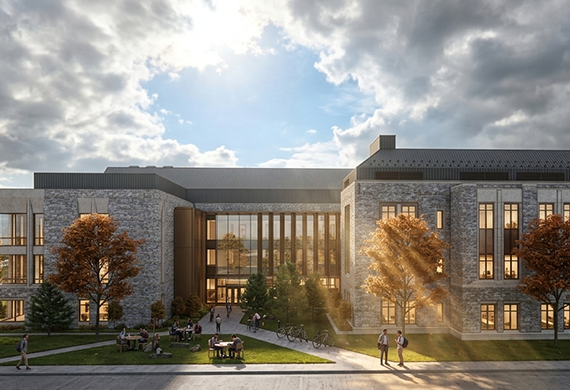
Marist Announces Ambitious $100 Million Science and Health Initiative
Marist University is investing $100 million to launch a comprehensive Science and Health Initiative to expand academic programs, modernize facilities, and strengthen partnerships to meet growing student interest and workforce demand. Grounded in Marist's "and" not "or" philosophy, the initiative blends rigorous scientific training with the critical thinking, ethics, communication, and leadership skills that today's scientific and clinical professions demand.
Whether you’re more interested in the science behind environmental systems or you intend to fight for environmentally conscious policies, Marist’s Environmental Science and Policy major allows you to customize your academic experience to best suit your career goals.
Learn how to detect and solve environmental problems using physical, chemical, and biological techniques, and how to identify and understand the underlying processes controlling them. You’ll be prepared to work for environmental labs, consulting firms, natural resource and regulatory agencies, green technology companies, as well as research organizations, through a customizable set of courses. Classroom and field-based experience use a diversity of hands-on, project-based, or team-based approaches to thoroughly prepare you with the skills you’ll need to pursue a career or graduate studies in the environmental sciences or related fields.
This degree is directed toward the implementation of complex environmental solutions, balancing policy-oriented approaches to environmental problems with knowledge on the science behind them. You’ll learn how to develop and evaluate cost-effective policy alternatives, generate public and political support for resource utilization practices that lower humanity's impact on the planet, enact legislation, and devise mechanisms that invite or ensure compliance or enhance understanding of the issue. Course selection is flexible to allow customization to your own interests within areas of law, business, communication, sustainability, climate, technology, and other diverse aspects of environmental justice and equity.
This BA focuses on outdoor-based, hands-on courses that develop your scientific intellect and effective communication skills through curricular experiences that emphasize project-based learning. Courses put theory into practice through applied, real-world approaches that allow you to grow your skills in analytical and team-based methodologies – competitively preparing you as an environmental professional ready for a diversity of job types in the sciences. This degree is designed to be paired easily with Marist’s Masters in Adolescence Education (Grades 7-12). This pairing creates a joint 5-year BA/Masters program where you become eligible for teaching certification in Earth science education by also completing education-focused coursework and student teaching at the Masters level.
The program offers three possible minors, ranging from 18-29 credits. The Environmental Policy Minor provides a look into the issues, policies, and laws regarding the environment. The Environmental Science Minor provides a foundation in the natural and physical sciences as they pertain to environmental studies. The Environmental Studies Minor combines a balance of both environmental science and policy. These minors are well-suited for students of any major, like business, communication, psychology, etc.
Turn Your Passion for the Environment Into Impact
Located in the heart of the Hudson River Valley, Marist University provides a wide range of environmental learning opportunities. Students in the Environmental Science and Policy program can channel their passion for environmental awareness into successful and meaningful careers. With direct access to the Hudson River and the abundant resources of the Hudson River Valley, students benefit from extensive connections in the field and expert faculty dedicated to their success. This supportive environment prepares students to make a significant impact on the future of the global environment.
Not only are Marist faculty at the top of their fields with active experience in the workforce, but they are also deeply invested in their students' success, frequently engaging them in professional research and educational trips. Meet a few of the Environmental faculty below, or view all our faculty members >
Dr. Richard Feldman is an Associate Professor of Environmental Science with research interests spanning sustainable agriculture, freshwater ecology, restoration ecology, biodiversity, and invasive species management. His work includes the stewardship of natural areas such as the Fern Tor Nature Preserve and innovative approaches to controlling invasive species like Japanese knotweed.
Dr. Laungani has been teaching at the undergraduate level for more than 20 years. His background in climate change, nutrient cycling, and plant ecology allow his students to explore the world across scales, from the molecular to the ecological. In his teaching, Dr. Laungani fosters a classroom environment where students are encouraged to take intellectual risks and engage in hypothesis-driven exploration.
Dr. Katherine Weiss is an Assistant Professor of Environmental Science and an urban wildlife ecologist whose research focuses on how urbanization affects wildlife communities and human-wildlife interactions. She studies mammal behavior, species interactions, and conservation strategies that promote coexistence between people and wildlife in increasingly urban environments. Her work also supports the management and recovery of threatened and endangered species through science-based conservation planning and decision-making.
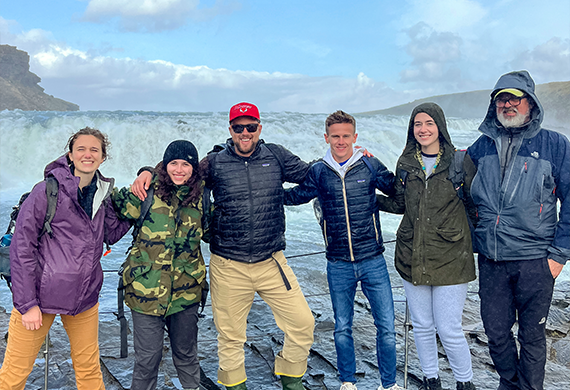
Environmental Science Students Turn Iceland into Their Classroom
As the Department Chair and Associate Professor of Environmental Science, Dr. Zion Klos emphasizes the significance of hands-on learning for student success. In partnership with Marist's short-term attachment programs, Environmental Science students accompanied Dr. Klos to Iceland, where they explored the dynamic relationship between environmental systems and human impact. The trip provided an engaging educational experience, allowing students to study course topics while hiking volcanoes, sailing on glacial lagoons, soaking in geyser-fed hot springs, and visiting iconic waterfalls, black sand beaches, and national parks.
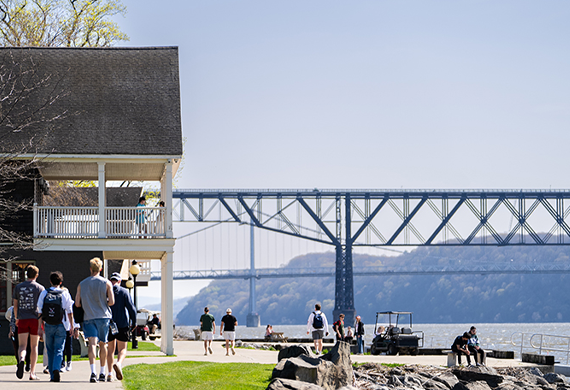
Marist Awarded Grant Funding to Support Environmental Education
Marist University has been awarded nearly $100,000 in New York State grant funding to support an innovative environmental education project that connects elementary classrooms with real-world climate and data science learning focused on the Hudson River. The work will also engage Marist students in hands-on, interdisciplinary learning that bridges environmental science and classroom teaching.
The Marist project, titled Real-world Investigations into Plants, Pollution, and Life on the Ever-Changing Hudson (RIPPLE Hudson), will partner with local non-profit organizations like the Mid-Hudson Discovery Museum, the Walkway Over the Hudson, and ConveyOR Art Gallery to engage in this work.
Our location on the banks of the Hudson River provides ample opportunity for aquatic research and for use as a field site for class use. The River Lab, run out of the Cornell Boathouse on the Marist riverfront, has a flow-through system which allows students to extract water and river wildlife to test for research experiments. Marist is only thirty minutes from the Cary Institute of Ecosystem Studies, where our students can intern with two dozen scientists on cutting-edge ecological research.
Students examine the impact of the introduced plant species, water chestnuts, on water quality and the Hudson River ecosystem. They collect data on oxygen levels, fish biodiversity, water pH, and water temperature, along with other measures of water quality.
Engaging in hands-on learning both inside and outside of the classroom is a staple of the Marist educational experience, and the Environmental Science and Policy program takes that to the next level. You’ll be encouraged to gain real-world acumen by completing internships at locations that match your future goals. Below are only a handful of locations at which Environmental Science and Policy students have completed internships.


Graduates with an Environmental Science degree from Marist University are prepared for careers in environmental laboratories, consulting firms, natural resource and regulatory agencies, green technology companies, and research organizations. They use physical, chemical, and biological methods to detect and solve environmental problems—bridging scientific know-how with real-world impact on ecosystems and policy.
Marist University stands out for its hands-on Environmental Science and Policy learning on the East Coast, thanks to its location and access to the Hudson River. Surrounded by the rich resources of the Hudson River Valley, Marist integrates fieldwork directly on campus and into the curriculum, using facilities such as the River Lab and Fern Tor Nature Preserve. The Environmental Science and Policy program offers project-based, team-based, and field-based courses led by faculty experts.
The Environmental Science and Policy program at Marist offers the study of physical, chemical, and biological techniques for addressing environmental issues. Coursework includes field-based research, chemistry, biology, policy analysis, critical thinking, and communication, all supported by our hands-on, experiential learning approach in the Hudson River Valley.
Explore the Environmental Science and Policy program curriculum >
Welcoming New Faculty Members

Marist Climbs to a New High in U.S. News Rankings

Marist Welcomes First-Year Students