

Business and Marketing Students Dive into Biometric Research to Decode Consumer Behavior
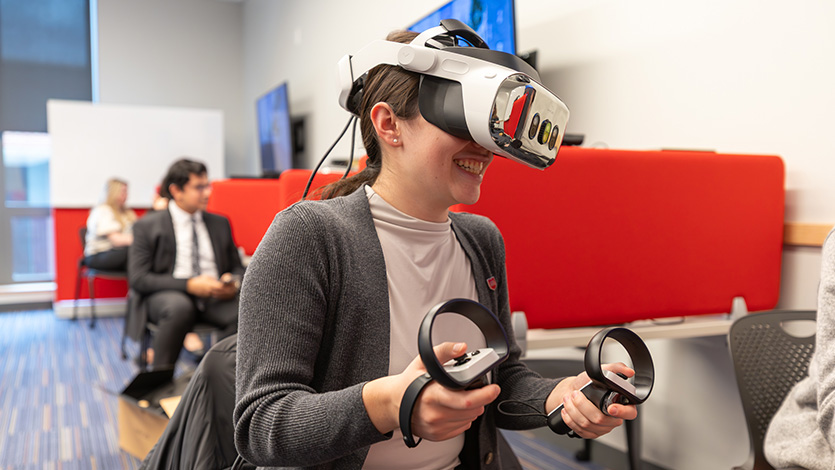
Students gain hands-on experience with cutting-edge technologies during an intensive workshop in the Marketing Intelligence Lab led by iMotions. Photo by Emily Portnov '29/Marist University.
December 9, 2025 — If you’ve ever wondered what it might be like to read another person’s mind, students in the School of Management recently had a chance to find out.
During an intensive two-day training held in the Dyson Center’s Marketing Intelligence Lab, students gained hands-on experience working with biometric research technology to track where people look, measure physical responses like excitement, and even monitor brain activity. The training also included analyzing facial expressions and voice patterns, as well as using virtual reality systems equipped with eye-tracking features.
The workshop was led by iMotions, a global leader in biometric research technology. It focused on helping students learn to capture the implicit, physiological dimensions of decision-making.
Nam Nguyen, Senior Neuroscience Product Specialist at iMotions, trains students on eye-tracking technology during the workshop. Photo by Emily Portnov '29/Marist University.
"Being able to see real-time emotional and cognitive reactions provided a new perspective on how people engage with media, products, and experiences," said Karina Borysiak '28, a business administration major with a concentration in marketing who is currently conducting research with Dr. Mohammadali Koorank Beheshti, Assistant Professor of Marketing and Founding Director of the Lab.
"The Marketing Intelligence Lab provides students with a hands-on environment where they not only learn by doing but also generate new knowledge through applied research," said Dr. Beheshti.
Some students like Karina, who have completed the training, have already begun designing research projects that employ these tools.
Her current project is investigating whether AI influencers or human influencers are more effective at inspiring audiences and promoting themes such as body positivity and responsible consumption issues central to protecting the environment.
Madison Jensen '29, a double major in business administration and communications, appreciated how the training combined her interests in business and psychology. She and her partner used facial expression analysis and VR eye-tracking to conduct an experiment analyzing reactions to magazine covers.
"The technology was extremely impressive, and I felt it was very user-friendly," said Madison. "The devices extract loads of data, giving evaluations of joy, content, anger, measurements of areas of interest, and so much more."
Students gather and analyze data captured from their research training. Photo by Emily Portnov '29/Marist University.
Both students recognized the value this certification adds to their professional development. Karina, who is applying for summer internships, said the training gives her a competitive edge.
"I think employers will see this certification as a sign that I'm proactive and willing to challenge myself, and also that I'm able to work with innovative, data-driven technologies," she said.
The hands-on training aligns with Marist's commitment to experiential learning, giving students real-world experience with advanced equipment to solve key business problems. Having biometric technology available to undergraduate business students positions Marist as a leader in this emerging field.
“I am profoundly grateful for the opportunity to have conducted a workshop at Marist University,” said Nam Nguyen, Senior Neuroscience Product Specialist at iMotions. “The energy, curiosity, and depth of conversation with Marist's professors and students were truly inspiring, especially as we explored how to tap into their powerful entrepreneurial spirit.”
Students hold their certificates for completing the iMotions training. Photo courtesy of Mohammadali Koorank Beheshti, School of Management.
“The Marketing Intelligence Lab at Marist will be the hub for a robust and exciting marketing community that we are building,” said Dr. Barry Silverman, Schlobach Distinguished Chair in Business. “This training was an important first step in laying the groundwork for this community, and I am very much looking forward to leveraging this new knowledge with students and faculty while we conduct important research that supports the Marist network.”
Additional training sessions are planned for both students and faculty to help shape projects both on and off campus, providing resume-building experience for students as they solve strategic problems in real-world scenarios. Whether conducting research or serving as a research subject, the Marketing Intelligence Lab provides opportunities for students to gain unique skillsets that will serve them throughout their careers.


