

Senior Achieves Rare First-Authorship at Undergraduate Level in National Research Publication
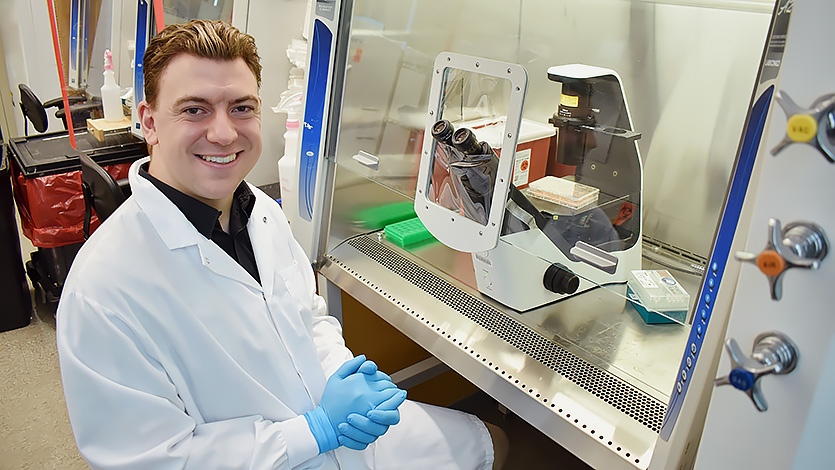
Jonathan monitors the development of human brain cells under the microscope at the Picower Institute for Learning and Memory (Tsai Laboratory), MIT. Photo courtesy of Jonathan Palmiero ’26.
February 24, 2026 — When Jonathan Palmiero ’26 learned that his research had been published in Molecular Biology of the Cell, it marked a milestone few undergraduates reach: first authorship on a peer-reviewed scientific paper. But for Jonathan, the achievement represents something larger than academic distinction. It reflects a trajectory shaped by discipline, curiosity, and a deep commitment to understanding and improving complex systems, from operating nuclear reactor systems in the U.S. Navy to studying the human brain.
A senior chemistry–biochemistry major with minors in math and biology, Jonathan is a member of the Honors Program, a former U.S. Navy nuclear electronics technician, and now a published researcher. Originally from Valhalla, New York, his path into neuroscience has taken many forms, but it has always been guided by a clear goal: using science and technology to better understand diseases like Alzheimer’s in service to others.
Brain Science Breakthroughs
In summer 2025, Jonathan participated in the MIT Summer Research Program in Biology and Neuroscience, where he studied Alzheimer’s disease at the Picower Institute for Learning and Memory. His work focused on myelin, the protective layer that helps brain cells send signals quickly and efficiently.
“You can think of a neuron like an electrical wire,” Jonathan said. “For electricity to travel efficiently, a wire needs insulation. In the brain, that insulation is called myelin.”
In Alzheimer’s disease, myelin becomes damaged, slowing communication between brain cells and contributing to memory loss and cognitive decline.
To study this process in humans, Jonathan used an advanced technique that reprograms human skin cells into brain cells, which then grow into tiny, three‑dimensional brain models called organoids. By comparing healthy organoids with those modeling Alzheimer’s disease, researchers can better understand how the disease disrupts neural communication — and how it might one day be repaired.
“Our research helps lay the groundwork for future studies aimed at understanding and potentially repairing the damage that occurs in neurodegenerative disease,” Jonathan said. “It’s a privilege to engage in work where discoveries can meaningfully improve human life.”
A Foundation Built in the U.S. Navy
Jonathan standing with his sister Arianna Palmiero ’22/’23M at his nuclear power school graduation. Photo courtesy of Jonathan Palmiero ’26.
Before coming to Marist, Jonathan spent six years in the U.S. Navy working as a nuclear electronics technician. He describes that time as the most challenging and formative six years of his life.
“In that environment, the standard was uncompromising,” he said. “Bringing nuclear power to foreign shores requires immense trust, earned only through flawless operation. In short, the military taught me what it means to be entrusted with something larger than myself.”
From Curiosity to Research at Marist
Jonathan presents research on lion’s mane during the 2025 CURSCA event in the Dyson Center. Photo by Carlo de Jesus/Marist University.
Jonathan’s interest in science began early, sparked by a fascination with lucid dreaming and questions about how the mind works. Over time, that curiosity matured into a desire to pursue research grounded in education and experience.
“It was humbling to discover that passion alone was insufficient to translate directly into a scientific role,” he said. “Additional education was needed to direct my curiosity and continue my journey.”
Using his GI Bill benefits, Jonathan enrolled at Marist and chose biochemistry because “it mirrored the framework of his naval training: starting with foundational principles and building toward tangible outcomes.” His sister Arianna Palmiero ’22/’23M also attended Marist in the MSEd program.
He joined a research lab during his first summer on campus and quickly found his footing.
Jonathan presents his research at an international conference in Barga, Italy, and is recognized with an abstract award. Photo courtesy of Jonathan Palmiero ’26.
Jonathan credits a strong network of Marist mentors for shaping his growth as a researcher and scholar.
“From the beginning, I was struck by Jonathan’s curiosity, motivation, and clarity of purpose,” said Dr. Michel Becuwe, Assistant Professor of Biology and mentor to his recent research. “What began as a summer research project grew into three consecutive semesters of intensive work, culminating in a first-author publication in Molecular Biology of the Cell, co-authored with eight other Marist students.”
These early contributions were recognized with an abstract award at an international conference in Barga, Italy.
“Having our work published stands as a testament to the diligence and persistence of a phenomenal team of scientists,” Jonathan said. “I am truly grateful to Dr. Becuwe for his mentorship and to Marist for making these opportunities possible.”
Working alongside one of his mentors, Dr. Jennifer Han, Assistant Professor of Biology, Jonathan has also helped optimize the growth of Hericium erinaceus, or lion’s mane, an edible fungus studied for the brain‑supporting compounds it produces.
“Jonathan is among the most focused, dedicated students I have had the pleasure of mentoring, both in the classroom and in the laboratory,” said Dr. Han. “Working with Jonathan has been a delight, and I look forward to seeing where his scientific pursuits take him.”
Unsurprisingly, Jonathan’s curiosity and drive have been evident to faculty across multiple research and academic settings at Marist.
“Jonathan has been a real joy to work with,” said Pat Taylor, Marist Graduate School and Fellowship Advisor. “He struck me immediately with this sense of a certain intellectual fearlessness, and I am confident that Jonathan is going to be a pivotal contributor as we deepen our understanding of the human mind and map the complementarities and discrepancies between the physical mind and its computing counterparts.”
“I was privileged to have Jonathan in three of my organic chemistry courses, and I have enjoyed being one of his many mentors here on campus,” said Dr. Jocelyn M. Nadeau, Associate Professor of Chemistry. “Jonathan is one of those students who stands out immediately to his professors because his intellectual intensity and curiosity are truly off the charts.”
Balance Beyond the Lab
Jonathan practices Tai Chi (left) and hangs out with his cat Zorra (right). Photos courtesy of Jonathan Palmiero ’26.
Beyond his academic work, Jonathan finds balance through Tai Chi and time spent with his cat Zorra, practices that reflect the patience and attentiveness he brings to scientific research. For Jonathan, even these quieter parts of his life reinforce the same principle that guides his work in the lab: service requires presence, patience, and care.
Jonathan’s success is rooted in much more than scholarly achievement. It reflects a long-held commitment to using science to serve others and improve human well-being.
“While doing this research, my focus shifted from ‘I want to study something’ to ‘I want to build something,’” Jonathan said. “Through understanding the brain, we can build technologies that integrate with it — not only to repair what is damaged, but to extend human capacity.”


