

Office Hours With Dr. Zion Klos, Department Chair and Associate Professor of Environmental Science
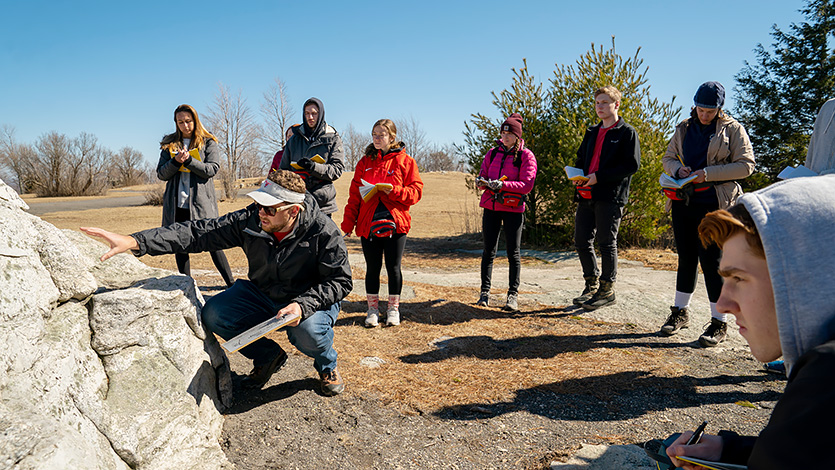
Dr. Zion Klos teaches environmental science students at Minnewaska State Park. Photo by Carlo de Jesus/Marist University.
Office Hours is a recurring segment where the Inside Marist team sparks conversations with key members of the campus community. Find out more about the inner workings of the University, gain fresh perspectives, and celebrate the invaluable contributions of those who make Marist the vibrant community that it is.
In this segment, Inside Marist’s Michelle Eggink interviews Dr. Zion Klos, Department Chair and Associate Professor of Environmental Science. Dr. Klos holds a Bachelor of Arts in Geology from Colorado College and a PhD in Environmental Science in Hydrology from the University of Idaho, where he was a National Science Foundation Graduate Research Fellow. He later completed postdoctoral research at the University of California, Santa Barbara.
An environmental Earth scientist, Dr. Klos focuses on hydrology, climate science, and the integration of physical and social systems. He has been widely published in peer reviewed journals, and his research has been featured in national media outlets. At Marist, he leads student-centered, outdoor-based, research that equips students with the skills and confidence to tackle complex environmental challenges in the Hudson Valley and beyond.
Q: Why is it important to study outside a traditional classroom?
A: Outdoor learning creates shared experiences that are challenging and deeply rewarding. Students learn they can handle uncertainty, work through obstacles, and reflect on growth. That confidence carries into life after college, when the stakes feel higher and the path might be less clear.
Q: Where are you from originally, and how did your upbringing shape you as an educator?
A: I’m from Wisconsin near Green Bay. I had an experiential childhood on a small farm with dairy goats, pigs, and cows, and we spent most of our time outside. That shaped my love of the outdoors and my curiosity about how things work, which led me to environmental science.
In sixth grade, my parents sold the animals, restored an old wooden sailboat, and we sailed from Wisconsin through the Caribbean and back while I was homeschooled. Later, I attended a boarding school in the Northwoods focused on environmental education and outdoor learning. That experience shaped my belief that getting students outside transforms how education feels.
Dr. Zion Klos leads the Environmental Science Department's Social-Ecological Systems Spring Attachment program to Iceland. Photo courtesy of Dr. Zion Klos and Emma Butzler '22.
Q: Where’s the best place to hike or explore in the Hudson Valley?
A: Farm Lane, about five minutes north of campus. It is national park land between the Valkill and FDR sites, with winding single track trails, creeks, ponds, and constant terrain changes.
Q: What’s the most memorable or unexpected thing that’s happened to you while doing fieldwork?
A: I was rafting the Zambezi River in southern Africa collecting sediment samples to study microplastics. We were camping on islands and navigating around hippos and crocodiles, which already keeps you alert. At one point, I was caught in a massive whirlpool nearly fifty feet across, where the water was spinning so fast it formed walls around the edges.
Q: As a hydrologist, do you have a favorite kind of weather?
A: A big rainstorm. Most of the processes that shape a landscape happen during intense rain, and you can watch change unfold in real time.
Q: What makes the Hudson Valley a great place to study Earth science?
A: The Hudson Valley is remarkable because it is one of only two places in the United States where you can see nearly one billion years of North American rock record. The diversity of geological history here is extraordinary.
This landscape has been under oceans, shaped by mountain building, and covered by a massive glacier nearly a mile thick. Seeing that scale of change reminds us that the Earth has always evolved and life has always adapted. That perspective brings balance and hope, and helps students see themselves as part of shaping what comes next.
Dr. Zion Klos teaches environmental science students in the stream at Wappingers Creek. Photo by Yasir Olenja '24/Marist University.
Q: You also lead immersive field and attachment courses in places like Iceland, Alaska, and Marist Italy. How do experiences like these help students understand environmental systems in a deeper way?
A: These courses help students see how complex environmental systems function in the real world. Using a social-ecological systems framework, we examine how landscapes, communities, and economies interact and how systems respond to stress, sometimes collapsing and reorganizing over time.
In Iceland and Alaska, students study how communities live closely with their environments while learning about natural hazards, land management, and industries like fishing. We sea kayak along the Alaskan coast, where sea lions surface beside our boats and orcas and sea otters move through the water. Students backpack across Icelandic landscapes, forage for native foods, and experience these environments firsthand.
In Italy, we study river systems like the Arno in Tuscany and compare them with rivers in the Hudson Valley, examining aquatic ecosystems and how human activity shapes them. Across these trips, students zoom in on ecological details while stepping back to understand how entire systems function and how communities respond creatively to environmental challenges.
Q: You’ve studied water and climate everywhere from mountain systems in the western U.S. to Costa Rica, and you serve on several local science advisory boards. What first drew you to water as a lens for understanding the world?
A: Water is a unifying element. Without liquid water, life would not exist. As climate change accelerates, it becomes both a critical resource and a growing hazard.
Much of the work I do with students comes back to water, especially flooding and harmful algal blooms. Through my advisory board work, I often help community groups think through water related challenges and look for ways to involve students. Turning real world questions into student led research is powerful. Students support communities, share findings, and build experience that shapes what they do next.
Dr. Zion Klos hikes with students on an attachment course in Alaska. Photo courtesy of Dr. Zion Klos.
Q: How do students move from curiosity to real world experience here at Marist?
A: Our open door culture makes a real difference. Office hours are not just about coursework. They are conversations about your interests, your goals, and what experiences might help you move forward. Because of that, students do not have to wait until senior year to get involved. Early on, they can join faculty-led research, design mentored projects, work with community partners in the Hudson Valley, and gain hands-on field experience. Many present at conferences, publish their work, or secure internships that grow from those relationships.
Q: Why is understanding human behavior just as important as understanding natural science when it comes to environmental issues like climate change?
A: Science explains how systems work and how they are connected. But problems are not solved unless people change policies, behaviors, and the systems that shape decisions. You have to reach both people’s minds and their hearts. Environmental and social issues are deeply intertwined. Solving them requires holistic thinking and collective effort. Even small contributions can move the larger system in the right direction.
Q: As department chair, what are you most excited about when it comes to the future of environmental science at Marist?
A: I’m excited about the breadth of pathways available to students. In recent years, we launched environmental studies alongside environmental science and strengthened partnerships that allow students to pursue teaching certification and other interdisciplinary interests.
Our focus is on helping students build strong technical foundations and the systems thinking skills needed to navigate complex challenges. That combination of depth and flexibility is what excites me most.
Q: What’s one piece of advice you would give to students who want to make a change and be environmental leaders?
A: Start with what excites you and the strengths you already have. Ask how those skills can make something better. When you lean into what energizes you, momentum builds and opportunities follow.
You do not have to have everything figured out. College is a time to experiment, reflect, and stay open. The thing that shapes your future might be something you have not discovered yet.


