

Game Design Ranked Top Program in the Nation for 11th Consecutive Year
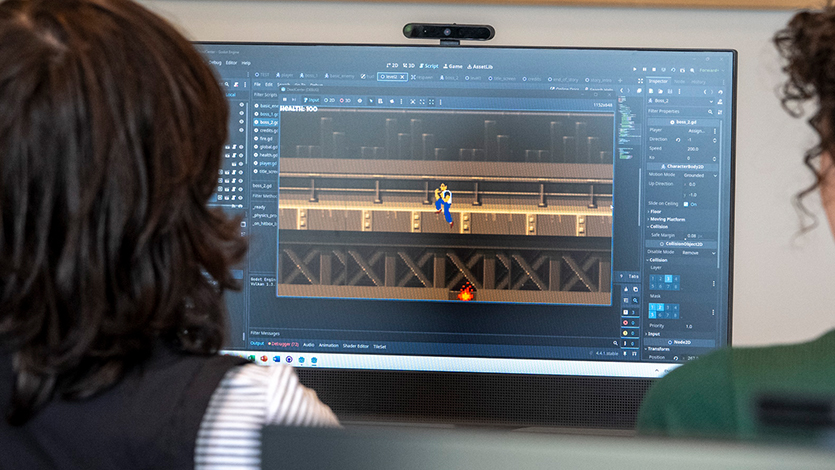
Students work on a computer game as part of Marist pre-college. Photo by Carlo de Jesus/Marist University.
In This Story...
- Marist University’s Games and Emerging Media program was ranked among the nation’s top game design programs for the 11th consecutive year by The Princeton Review.
- Student research and creative work drive the program’s national recognition, with projects examining ethical, inclusive, and educational dimensions of gaming—from monetization practices and online culture to AI‑supported learning tools.
- Faculty mentorship, industry engagement, and state‑of‑the‑art resources underscore Marist’s commitment to excellence in game design education.
March 31, 2026 — For the 11th straight year, Marist has earned a spot among the top game design programs in the country.
The annual rankings from The Princeton Review place Marist in the top 10 in the northeast and the top 50 nationally, a distinction that reflects the ambition and dedication of the students and faculty in the Games and Emerging Media program.
“I am really proud that The Princeton Review has honored the amazing work of our supportive faculty and staff, and the fantastic talent of our students,” said Dr. Karen Schrier, Director of Games and Emerging Media. “The strength of this program comes from our talented, caring community, who create a space where we all support one another, collaborate, and feel empowered to express ourselves."
Students in Dr. Schrier's Game Design class in Lowell Thomas developing Escape Rooms. Photo by Nelson Echeverria/Marist University.
This nation-leading excellence is on display in the work of students like Aidan Parascando '26, a double major in games and emerging media and English, whose honors research project examines predatory monetization practices in the gaming industry.
This project has not only taught Aidan about the complexities of the gaming world, but also about international law and regulation in relation to monetization and gambling.
“I wanted to bring this issue to the attention of people who might not be familiar with the situation or gaming culture in general,” Aidan said. “I had a lot of fun dissecting the numbers behind a predatory gambling system in a popular card game I play, and it was particularly rewarding to show people just how much money can be spent on small elements of a game.”
Alongside his research, Aidan worked with Dr. Schrier on researching an educational game called Quandary, and the use of an AI chatbot to help children think through ethical questions in the classroom.
The experience, he said, gave him a new appreciation for the potential of games and technology as tools for learning and positive impact.
Daniel Brogan '26 studied the intersection of gaming and ethics from a different angle.
Left: Daniel Brogan '26 with his classmate Victor Rivera Jr. '27 at their honors thesis presentation. Right: Daniel with his trophy after the Overwatch 2 team won the West Point Invitational. Photos courtesy of Daniel Brogan '26.
His honors thesis investigated sexism within online gaming communities.
Using Call of Duty as a case study, Daniel documented frequency of hostile comments with the goal of shining a light on barriers that make gaming feel unwelcoming to many players.
“I have always enjoyed trying to make what are supposed to be safe spaces truly safe,” Daniel said. “Through my research, I was able to take a video game which is supposed to be a fun and safe space for all and figure out how to make that space truly welcoming, where everyone can enjoy it.”
Beyond his research, Daniel has been a driving force in Marist's Esports program, serving as vice president and captain of the Overwatch 2 team.
Guests at Admitted Student Day speak to members of the Esports team in the new Esports Lab in Donnelly Hall. Photo by Carlo de Jesus/Marist University.
Both students pointed to the people around them, including their faculty and mentors, as a defining feature of the program.
"The best part of studying games at Marist is undoubtedly the people," Aidan said. "It's rare to have so many individuals who share your passions and aspirations gathered in one place."
“The work of my gaming students really inspires me,” Dr. Schrier said. “They care about making games more ethical, inclusive, and safe.”
That community spirit extends beyond the classroom with visits from alumni such as Ron Marz '87, a narrative designer at Blizzard Entertainment.
Ron Marz '87 of Blizzard Entertaintment networks with students in the Hancock Center. Photos by Tori Hegenauer '27/Marist University.
Marz, who spent more than three decades writing for Marvel Comics, DC Comics, and other major publishers before transitioning to game development, spoke to dozens of students about what it actually looks like to build a career in the industry. In the event presented by the Center for Career Services, he emphasized that game development is a deeply collaborative process, and the importance of communication, adaptability, and professionalism.
The Games and Emerging Media program's reach extends well beyond campus.
Dr. Schrier was awarded a Fulbright Specialist Program grant to teach game design at the Higher Institute of Multimedia Arts of Manouba in Tunisia. There, she led workshops helping faculty integrate game design and game studies into their teaching, and collaborated with the U.S. Embassy on additional educational outreach.
On campus, Marist is investing in the future of gaming with the opening of a new, expanded Esports Lab in Donnelly Hall. The state-of-the-art facility features high-performance gaming stations, private competition rooms, streaming capabilities, and collaborative spaces for team strategy and play. It is among the largest esports facilities in the Metro Atlantic Athletic Conference.
Marketing and communiations student worker Tori Hegenauer '27 contributed to this article.


