

Victor Rivera Jr. '27 Honored as Marist’s First-Ever Truman Scholar
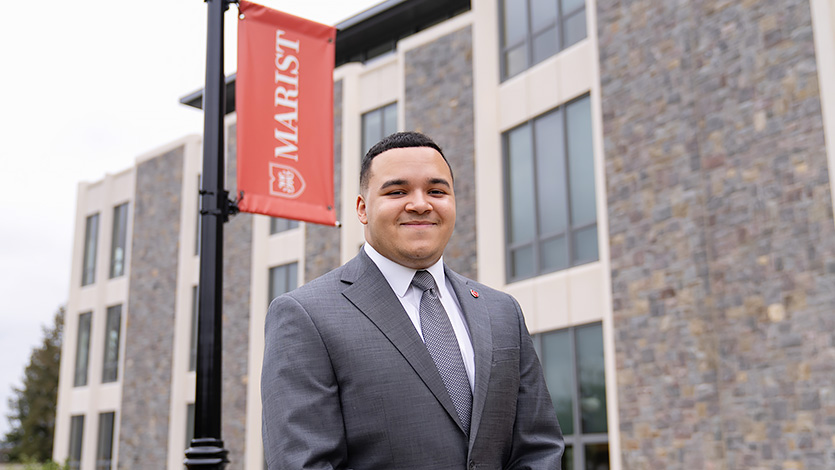
Social Work major Victor Rivera, Jr. '27 has been awarded a prestigious Harry S. Truman Scholarship—the first ever in Marist history—in his pursuit of a career in public service. Photo by Nelson Echeverria/Marist University.
April 24, 2026 — Victor Rivera Jr. '27 has been awarded the Harry S. Truman Scholarship, one of the nation’s most competitive and prestigious honors for students pursuing careers in public service—the first Truman Scholar in Marist University’s history. He is also one of just 55 selected nationwide this year.
A member of the Marist Honors Program, Victor was chosen from a highly competitive national pool. Widely regarded as the premier graduate fellowship for public service—and presenting a level of competitiveness on par with the Rhodes and Marshall Scholarships—the Truman Scholarship recognizes exceptional leadership, academic excellence, and a deep commitment to community impact.
A junior, Victor was selected as a Truman Scholar representing his home state of Massachusetts.
A first-generation college student majoring in Social Work, Victor plans to pursue a career in law enforcement informed by clinical social work training. He aspires to become a police officer prepared to respond effectively to mental health crises through de-escalation, collaboration, and evidence-based practices.
In his policy proposal for the scholarship submission, Victor called for incorporating 40 hours of Crisis Intervention Team training into police academy curricula—far exceeding the limited mental health training typically required. His proposal comes amid growing public concern over encounters between law enforcement and individuals experiencing mental health crises.
“Being named a Truman Scholar expands my access to higher education and professional networks that might not otherwise have been available to me,” Victor said. “As a first-generation college student, this recognition affirms both my commitment to public service and the institutional support behind me—it’s a powerful vote of confidence from leaders dedicated to serving the public good.”
Throughout his time at Marist, Victor has worked closely with Dr. Darren Cosgrove, Assistant Professor of Social Work and his academic advisor, whose mentorship across coursework, Honors advising, and research has played a central role in his development.
“Victor's skills as a rigorous and academically gifted student, and his commitment to transformative and equity-focused practice, lends itself to him standing out as someone well-suited to contribute to the solving of deeply complex social issues and institutional problems,” said Dr. Cosgrove. “His perspective, content comprehension, and excellence in critical analysis has positioned him as someone his peers and faculty admire and learn from.”
Through Marist’s Social Work program, Victor has gained hands-on experience addressing community needs through his internship at the Dutchess County Department of Mental Health’s Empowerment Center, where he has worked since Fall 2025. His work has included supporting countywide outreach for the Dutchess County Opioid Task Force Survey and translating the center’s signage and resources into Spanish to help increase accessibility for Spanish-speaking communities.
Victor Rivera, Jr. ’27, Harry S. Truman Scholarship recipient, in the Dyson Center. Photo by Nelson Echeverria/Marist University.
As a sophomore, Victor studied abroad in Cape Town, South Africa, participating in a service-learning experience with a housing advocacy organization focused on equity and access. The experience broadened his understanding of social systems and reinforced his commitment to public service at both local and global levels.
The Truman Scholarship provides funding for graduate study, leadership development programming, and access to federal internships and career mentorship. Victor plans to pursue graduate training that integrates clinical social work and law enforcement preparation, positioning him to serve as both a practitioner and future leader in public safety reform.
“My research is intended to highlight voices and realities that have been historically suppressed,” Victor said. “By bringing data and scientific inquiry into these conversations, I hope to help secure better outcomes for crisis intervention and interactions with government systems.”
Victor cites Marist’s Office of Academic Affairs for their guidance throughout the application process. In particular, he credits Pat Taylor, Graduate School and Fellowship Advisor and the University’s Truman Advisor. The Truman Scholarship is part of Taylor’s portfolio of scholarship opportunities, which also includes Fulbright Scholarships and other awards.
“Working with Victor was endlessly rewarding,” said Taylor. “I started with an initial impression of Victor as an energetic and highly engaged first-year student. Now, in his senior year, I encounter a young man who has grown and matured into a deeply thoughtful, profoundly committed and ethical person who will help us to reintroduce humaneness into public security.”
“Victor has taken advantage of every opportunity to learn and challenge himself as a student at Marist,” said Dr. James Snyder, Dean for Academic Engagement. “His success speaks to the deep, broad, and complex learning that takes place when our students work closely with faculty mentors and advisors like Darren Cosgrove and Pat Taylor, who are dedicated to bringing out the very best in our students. I think it’s important to note the special role that Victor’s honors thesis project played in shaping his Truman application. The independent projects that our students are doing with Marist faculty is shaping knowledge and the future.”
About the Truman Scholarship
The highly selective Truman Scholarship challenges applicants to demonstrate community impact and leadership, outline graduate study and career goals, and propose a policy solution to a pressing societal issue. This year, 198 finalists were chosen from 781 applicants representing 305 institutions, advancing to a rigorous interview process conducted by panels that often include former Truman Scholars.
Established by an act of Congress in 1975 as a living memorial to the 33rd president of the United States, the Harry S. Truman Scholarship honors college juniors who demonstrate outstanding leadership, academic excellence, and a sustained commitment to public service. The program annually provides up to $30,000 in funding for graduate education and access to a national network of scholars and mentors.


