




-
About
Marist University Commencement
Celebrating the class of 2026!
• The Graduate Ceremony will be held on Thursday, May 21.
• The Undergraduate Ceremony will be held on Friday, May 22.About
-
Academics
Marist University Commencement
Celebrating the class of 2026!
• The Graduate Ceremony will be held on Thursday, May 21.
• The Undergraduate Ceremony will be held on Friday, May 22.Academics
-
Admission & Financial Aid
Marist University Commencement
Celebrating the class of 2026!
• The Graduate Ceremony will be held on Thursday, May 21.
• The Undergraduate Ceremony will be held on Friday, May 22.Admission & Financial Aid
-
Student Life
Marist University Commencement
Celebrating the class of 2026!
• The Graduate Ceremony will be held on Thursday, May 21.
• The Undergraduate Ceremony will be held on Friday, May 22.Student Life
- Athletics
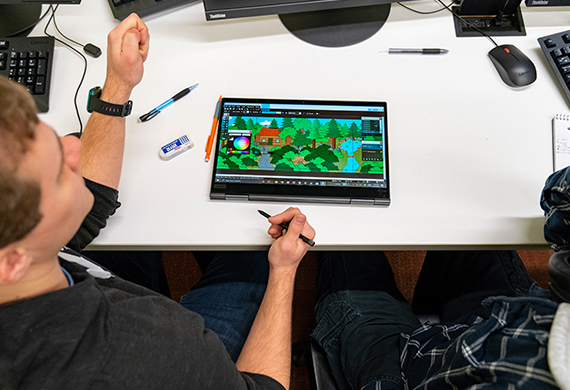
Image of Marist University User Experience (UX) Design minor student working on a laptop.
Image of Marist Red M background.
Where Creativity Meets Technology
The User Experience (UX) Design minor unites creativity with technology. Students gain the essential knowledge and skills needed to analyze, prototype, and design media across a range of fields, including communications, gaming, health, education, marketing, and finance. By making powerful designs, students can create meaningful experiences for the future.
An Integrative, Interdisciplinary Minor
The User Experience (UX) Design minor is housed within the Art and Digital Media department, but is interdisciplinary, enabling integration across various academic fields. This versatility enhances students' marketability in a competitive job market.
Students must take three required foundational courses: Introduction to Visual Design, User Experience (UX) Design, and Advanced User Experience (UX) Design. Students choose three additional courses to complete the minor. Options include:
- Interactive Storytelling
- Online Culture
- Designing for the Web
- Human-Computer Interaction
- Ethical & Inclusive Design
The Benefits of a Strong Foundation
Introduction to Visual Design
Use media to more effectively communicate ideas, perspectives, and knowledge
User Experience (UX) Design
Practice various techniques and approaches that can be used to design interactive media, such as websites, games, blogs, e-books, and apps
Advanced User Experience
Develop a deeper understanding of the design process, with a focus on information architecture, user testing, and prototyping.
Dedicated Faculty who Bring Diverse Skills and Real-World Knowledge to the Classroom
Marist faculty members bring a wide range of backgrounds and expertise, providing students the opportunity to learn from industry experts. With small class sizes, students receive personalized attention and hands-on experience. Students acquire essential knowledge and skills to analyze, shape, and design media for future websites, apps, games, and more.
Karen Schrier
Dr Karen "Kat" Schrier is the Founding Director of the Games & Emerging Media program and Coordinator of the UX Minor. She has over 25 years of experience in games and media production, design, and writing, at places like Nickelodeon, Scholastic, PBS, and the World Health Organization. She is a top expert on games, empathy, and ethics. Her latest book is called We the Gamers: How Games Teach Ethics and Civics (Oxford University Press).
Ron Coleman
A two-time recipient of the IBM Faculty Innovation Award, Dr. Coleman has worked for AT&T as a software developer, at IBM as an advisory engineer in the Supercomputing Systems Lab, and Citigroup as a software developer, analyst, and vice president in risk management technology. His research focuses primarily on software development, parallel computing, and games.
Mengqi Gao
Mengqi Gao is a game designer, artist, and writer. She makes games, abstract art, poetry, fiction, and electronic literature. She is also interested in playing and mixing different mediums in her work. Her work explores the topics of mental health, feminism, queerness, racism, bilingual texts, and translations.
Marist Game Design Ranked Top Program in the Country
For the tenth consecutive year, Marist has been recognized as one of the top gaming design programs in the nation. The Princeton Review's annual list ranks Marist among the top 50 in the nation and the top 10 in the Northeast for undergraduate students. Marist's Games and Emerging Media program equips students with the creative and technical skills needed to succeed as designers, writers, animators, programmers, and industry leaders, supported by expert faculty and state-of-the-art facilities.
Read More >
Games and Emerging Media Program >
Image of the Marist rotunda.
The Value of a Marist Education
Marist cultivates the intellectual growth and well-being of its students through unique and personalized combinations of coursework and experience in and out of the classroom. These experiences provide valuable personal growth and occupational expertise to reflect students' individual passions.
94%
Employed or attending grad school 6 months after graduation
83%
Of Marist Graduates Participated in one or more internships
82%
Graduation rate, higher than the average for public and private colleges
#1
Marist study abroad is the national leader for academic year programs, per Open Doors Report.

Top 10 Regional Universities-North
TOP25
Top 20 for Most Innovative Universities-North Region, per The Princeton Review.
Featured News
A transformative investment starting in the 2026-27 academic year will open doors for more students while fueling Marist's growing academic impact.
SCA’s Inaugural Student Showcase: Where Student Passion Meets the Alumni Network
From passion projects to professional advice, School of Communication and the Arts students showcased their work and connected with alumni shaping today’s communication and fashion industries. Go inside the April 10 showcase.
Earth Week at Marist Highlights Student Leadership in Sustainability
Student leaders turned sustainability into action through hands-on efforts that built community, encouraged care for the campus environment, and reflected Marist’s connection between real-world engagement and personal well-being.


