

New AI Ethics Course Puts Human Values at the Center of Driving Technological Change
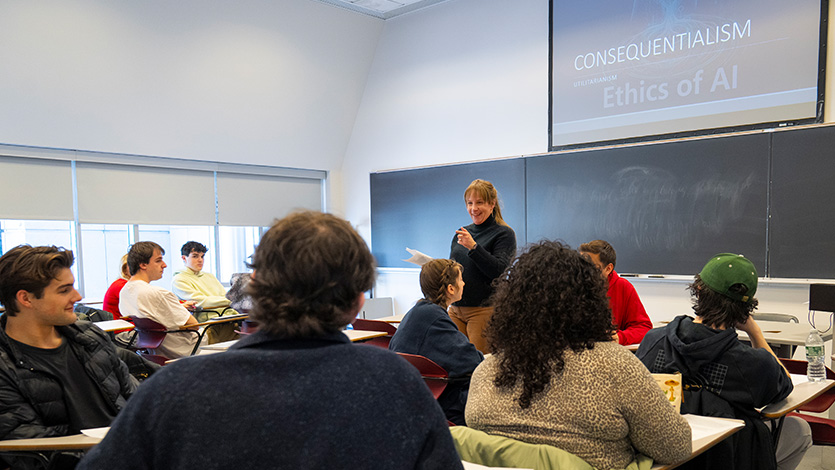
Students and Dr. Sasha Biro during a class discussion in the Ethics of Artificial Intelligence course. Photo by Carlo de Jesus/Marist University.
February 3, 2026 — As artificial intelligence reshapes academics, work, and nearly every aspect of the world around us, Marist is ensuring students can navigate this transformation thoughtfully and responsibly — and with the skills to succeed.
This spring, the School of Liberal Arts launched a new course —"Ethics of Artificial Intelligence" — that examines AI's profound implications for society while equipping students with the ethical frameworks needed to assess and use these technologies wisely.
The course is part of Marist's cross-disciplinary minor in Applied AI, which launched last fall to prepare students across all majors for an increasingly AI-driven world. The ethics course places students in the center of one of the most debated aspects of AI: how to remain human-centered while also allowing the technical benefits, knowledge, and practical skills to responsibly flourish with this rapidly advancing technology.
"When ChatGPT exploded onto the scene, it was this moment where educators were in the halls saying, 'Wow, this thing has dropped and it's already changing students' work,'" said Dr. Sasha Biro, Lecturer of philosophy and religious studies and the course instructor. "So I thought about how to address this constructively: here's this tool that can be used in wildly various ways—how do you address that in a classroom setting?"
A group discussion on ethical scenarios in the Ethics of Artificial Intelligence course. Photo by Carlo de Jesus/Marist University
Biro designed the course to help students think deeply about their relationship with these technologies. The semester begins with foundational moral theories that serve as a toolbox for examining AI's real-world impacts. Students then explore critical topics including the future of work, justice, bias, and education, examining how AI intersects with issues of equity and access.
"This new course speaks directly to the relevance of the liberal arts today as we navigate big changes to how we live and work," said James G. Snyder, Dean for Academic Engagement. "Ethics is central to the mission and values of Marist, and it's great to see our faculty develop innovative courses and programs to shed light on the meaning and value of profound changes we are seeing in our world today."
“I am extremely excited that it has become an option at the university as I see many opportunities growing for the field in the future,” said Carolyn Orcutt '27, a philosophy major and studio art minor who is currently in the class.
What makes the course distinctive is that students grapple with their own responsibilities as AI users. Biro allows students to use generative AI in their coursework, but with guidelines.
"I say to students, you can use generative AI however you would like, as long as it's ethical," said Biro. "But you have to acknowledge where your work has been enhanced by it and why."
Biro says sometimes we all can be nervous when using these new technologies, especially in the classroom.
“Students don't always want to acknowledge that because there's a taboo aspect about it. But we need to think about how we're using it,” she said.
This approach prepares students for a world where AI is ubiquitous and requires honest engagement, not avoidance. Biro has students compare their original thesis statements with AI-generated ones, examining which is stronger and why.
"There are going to be skills—critical thinking, empathy, judgment—that AI can't do for you," said Biro. "As we think about the future of work and what we'll value as a society, it's going to be these skills that the liberal arts cultivate. They can't just be put through a generator and refined."
Carolyn Orcutt '27 and her textbook during a class discussion. Photo by Carlo de Jesus/Marist University.
“I am very critical of AI technology, which is exactly why I wanted to push myself to learn how it works and how it positively impacts others,” said Carolyn. “I am excited to continue to engage with peers who may have different perspectives on the technology and who challenge me to approach AI with nuance.”
The semester concludes by asking students to consider their own futures. Through presentations and a final paper, students identify specific ethical issues in AI and propose solutions grounded in the what they've learned.
“Rather than prohibiting these tools, I want to focus on helping students learn how to use them responsibly and with academic integrity,” said Biro. “If a student wants to be prepared for a global society, they have to encounter and be reflexive with using AI.”


