-
About
Marist Fall 2026 Open House
Join us for a Fall Open House and see Marist for yourself. Explore our stunning riverfront campus, learn more about academics and admissions, and get a firsthand look at life as a Red Fox. Along the way, you'll hear from students, faculty, and staff about the opportunities, connections, and experiences that make Marist special. Register Below:
About
-
Academics
Marist Fall 2026 Open House
Join us for a Fall Open House and see Marist for yourself. Explore our stunning riverfront campus, learn more about academics and admissions, and get a firsthand look at life as a Red Fox. Along the way, you'll hear from students, faculty, and staff about the opportunities, connections, and experiences that make Marist special. Register Below:
Academics
-
Admission & Financial Aid
Marist Fall 2026 Open House
Join us for a Fall Open House and see Marist for yourself. Explore our stunning riverfront campus, learn more about academics and admissions, and get a firsthand look at life as a Red Fox. Along the way, you'll hear from students, faculty, and staff about the opportunities, connections, and experiences that make Marist special. Register Below:
Admission & Financial Aid
-
Student Life
Marist Fall 2026 Open House
Join us for a Fall Open House and see Marist for yourself. Explore our stunning riverfront campus, learn more about academics and admissions, and get a firsthand look at life as a Red Fox. Along the way, you'll hear from students, faculty, and staff about the opportunities, connections, and experiences that make Marist special. Register Below:
Student Life
- Athletics
Applied Artificial Intelligence
APPLY NOWHarness the Power of Artificial Intelligence
As one of the world's fastest-growing innovative technologies, having the skills and knowledge in artificial intelligence (AI) will help you bridge the gap between theoretical practice and practical application. With artificial intelligence influencing our lives, industries, and careers, an Applied AI minor will give you a competitive edge.
How is Marist using AI?
A Minor That Supports All Fields of Study
The Applied AI minor enhances any undergraduate degree by providing a comprehensive understanding of artificial intelligence. Students will learn AI principles, gain hands-on experience, and explore the ethical and societal impacts of AI.
There are three required courses: AI Literacy, Ethics of AI, and Applied AI, and three electives selected across each school, including options like:
- School of Communication and the Arts
- Human-Computer Interaction and Ethics and Gaming
- School of Computer Science and Mathematics
- Artificial Intelligence, Machine Learning, and Algorithm Analysis and Design
- School of Liberal Arts
- Writing in a Digital Age, Digital Humanities, and Moral Cognition
- School of Management
- The Business of Healthcare and AI in Marketing
- School of Science
- Earth System Science
- School of Social and Behavioral Science
- Foundations in Cognitive Science and Cognitive Psychology
Inspired by AI and Human Potential
After establishing his passion for computer science, Christian honed in on data science because of his fascination with artificial intelligence. "I realized the power of combining math and computer science to create innovative solutions captivated me and motivated me to learn as much as I could about it in every way possible," he said. After transferring to Marist during his sophomore year, the aspiring data scientist became the President of the Marist Analytics Community and a member of the Marist+AI initiative, working alongside administrators, faculty, and other campus leaders to help make decisions on how the university will utilize AI throughout its operations.
Applied AI Curriculum
The minor has three required courses and three interdisciplinary electives. The three required courses are as follows:
- CMPT110 AI Literacy
- PHIL 201 Ethics of AI
- CMPT201 Applied AI
Three interdisciplinary electives will be selected from courses across the School of Communication and the Arts, School of Computer Science and Mathematics, School of Liberal Arts, School of Management, and School of Social and Behavioral Science.
Marist Named as one of the Best for AI Preparedness
Marist University was named in Town & Country magazine's “15 Colleges Best Preparing Students for the AI Economy.” The recognition highlights Marist's distinctive “and, not or” academic approach—combining rigorous AI and technical training with ethical reflection, interdisciplinary learning, and real-world application. The list focused on schools that thoughtfully integrate AI across diverse areas, disciplines, and curricular pathways; focus on hands-on access and real-world application to ensure competency within and beyond technology; and demonstrate leadership in AI ethics, governance, and societal impact.
Read More About Marist's Ranking >
Learn How Marist is Preparing Every Student to be AI-Ready >
Coding and AI are not just passions for Christian—they're his calling.
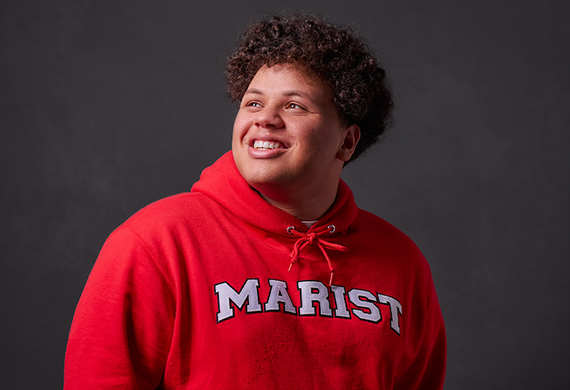
Inspired by AI and Human Potential, Christian Sarmiento '25, a data science and analytics major, dives into hands-on learning and research to uncover endless ways AI can shape the future. He also leads campus-wide talks on the responsible use of this revolutionary tech across industries. That's because Christian sees more than just data—he sees the human impact of innovation.
Learn from Knowledgeable Faculty with Diverse Expertise
Marist faculty members have myriad backgrounds and expertise, allowing students to learn from diverse industry experts. Small class sizes enable students to receive personal attention while gaining hands-on experience. As a result, students develop a comprehensive understanding of artificial intelligence and learn how to apply it effectively and ethically in their careers.
Dr. Biro's research explores the ethical implications of AI use, focusing on how it shapes societal norms and influences moral decision-making. Her applied ethics course, the Ethics of Artificial Intelligence, provides a philosophical framework for critically analyzing the ethical, metaphysical, and epistemological questions surrounding AI. Understanding these topics not only enriches students' comprehension of contemporary moral issues but also prepares them to engage thoughtfully with the ethical challenges posed by rapidly evolving technologies.
Dr. Lauría has led the development of the data science, business analytics, and artificial intelligence programs (graduate and undergraduate), including the newly developed MSCS and 5-year CS concentration in AI at Marist University. An expert in machine learning, data mining, and predictive analytics, with worldwide recognition in learning and academic analytics and artificial intelligence in education, Dr. Lauría brings extensive experience in applying data-driven insights to decision-making, enhancing learning environments, and advancing AI in education. Prof. Lauría is the recipient of the 2015 Board of Trustees Distinguished Teaching Award.
Dr. Matheus led the development and implementation of the Applied Artificial Intelligence minor at Marist University. In her AI Literacy course, she blends the technical foundations of AI with a humanistic exploration of its societal implications, ethical challenges, and interdisciplinary applications. Her innovative approach to teaching earned her the National Society of Leadership and Success Award for Excellence in Teaching.
Develop the Skills to Set You Apart
AI Literacy
Demonstrate knowledge of the fundamental principles and methods of artificial intelligence
Ethical and Social Issues of AI
Evaluate and apply ethical foundations to inform decision-making and examine the potential impacts of AI on society and individuals
AI Applications
Apply knowledge and technical skills to evaluate, utilize, and/or create AI tools to solve real-world problems across fields
Marist University's Applied AI Minor Frequently Asked Questions
An Artificial Intelligence (AI) minor can benefit nearly any undergraduate major by helping students develop practical AI skills, understand how artificial intelligence is transforming industries, and apply AI concepts to their chosen field. At Marist University, the Applied AI minor is specifically designed to support students across multiple disciplines, from business and marketing to computer science, communications, and the humanities. This interdisciplinary approach helps students bridge the gap between theory and practical application. It provides hands-on experience and insight into AI's societal impact, making students more competitive in a technology-driven job market.
An Artificial Intelligence minor can expand career opportunities in virtually every industry by providing foundational AI knowledge, ethical reasoning skills, and practical experience applying AI tools. Because Marist's Applied AI minor is designed to complement any major, graduates can leverage AI knowledge in a wide range of professions. Students learn how to evaluate, use, and create AI-driven solutions to solve real-world problems while gaining skills in AI literacy, ethical analysis, and practical AI applications. These capabilities can help graduates stand out in roles where understanding and applying AI is increasingly important. Career paths include:
- Business analyst
- Operations analyst
- Digital marketing specialist
- Machine learning support specialist
- Software developer
- Data science professional
- Cognitive science researcher
- Human-computer interaction specialist
- Technical writer
When evaluating Applied AI minor programs, look for universities that combine hands-on learning, interdisciplinary coursework, AI ethics, and real-world applications. Marist University's Applied AI minor is designed to support students across all academic disciplines; it includes required coursework in AI Literacy, Ethics of AI, and Applied AI, plus electives in fields such as business, computer science, communications, liberal arts, science, and psychology.
Marist was also recognized by Town & Country as one of the "15 Colleges Best Preparing Students for the AI Economy," citing its integration of AI across disciplines, emphasis on hands-on learning, focus on ethical AI use, and commitment to real-world application.
The Value of a Marist Education
Marist cultivates the intellectual growth and well-being of its students through unique and personalized combinations of coursework and experience in and out of the classroom. These experiences provide valuable personal growth and occupational expertise to reflect students' individual passions.
94%
Employed or attending grad school 6 months after graduation
83%
Of Marist Graduates Participated in one or more internships
82%
Graduation rate, higher than the average for public and private colleges
#1
Marist study abroad is the national leader for academic year programs, per Open Doors Report.