

Welcoming New Faculty Members
The University welcomes distinguished faculty and welcomes new members, reaffirming its commitment to academic excellence and student-centered learning.

Join us for our final Fall Open House and see Marist for yourself. Explore our stunning riverfront campus, learn more about academics and admissions, and get a firsthand look at life as a Red Fox. Along the way, you'll hear from students, faculty, and staff about the opportunities, connections, and experiences that make Marist special. Register Below:
Join us for our final Fall Open House and see Marist for yourself. Explore our stunning riverfront campus, learn more about academics and admissions, and get a firsthand look at life as a Red Fox. Along the way, you'll hear from students, faculty, and staff about the opportunities, connections, and experiences that make Marist special. Register Below:
Join us for our final Fall Open House and see Marist for yourself. Explore our stunning riverfront campus, learn more about academics and admissions, and get a firsthand look at life as a Red Fox. Along the way, you'll hear from students, faculty, and staff about the opportunities, connections, and experiences that make Marist special. Register Below:
Join us for our final Fall Open House and see Marist for yourself. Explore our stunning riverfront campus, learn more about academics and admissions, and get a firsthand look at life as a Red Fox. Along the way, you'll hear from students, faculty, and staff about the opportunities, connections, and experiences that make Marist special. Register Below:
The Economics program at Marist University prepares students to analyze and interpret economic systems through a combination of theory, data analysis, and applied learning. Students develop skills in modeling, research, and decision-making while exploring real-world economic issues and market behavior. Through internships and experiential opportunities, students apply their knowledge in professional settings. The program builds a strong foundation for careers in business, finance, policy, and advanced study.
95% of School of Management graduates are employed or pursuing graduate study within six months of graduation*.
* Based on a five-year average from Marist’s annual outcomes report (knowledge rate: 86.8%).
Applied learning through the Center for Business Experience, including data-driven analysis, financial modeling, and exposure to real-world economic decision-making environments.
A rigorous, analytical curriculum grounded in economic theory and liberal arts principles, taught by faculty with expertise in research, policy, and industry.
Access to New York City’s financial and corporate sectors and global markets, including internships and professional experiences with organizations such as JPMorgan Chase and IBM, as well as study opportunities in Florence and more than 30 countries worldwide.
What do you learn in an undergraduate Economics program?
An undergraduate Economics program teaches students how individuals, businesses, and governments make decisions about resources, markets, and public policy. As a result, economists play formative roles in government policymaking, fiscal planning, investing, and a variety of other in-demand professions, and, as such, are entrusted with enormous responsibility. At Marist University, the Economics program combines economic theory, quantitative analysis, technology, and liberal arts education to help students understand complex economic issues and apply their knowledge in real-world settings. As an Economics major, you will take courses like:

Hands-On Experiential Learning
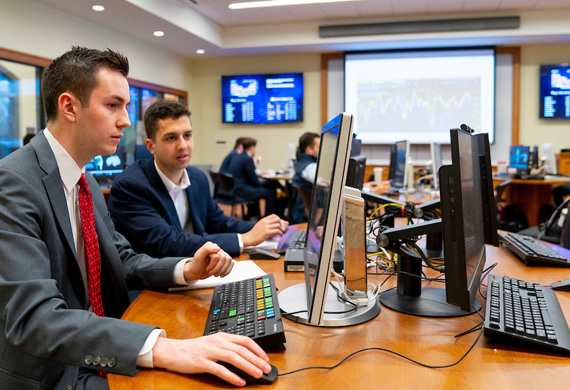
The difference between Marist Economics students and others is the extensive hands-on, experiential learning they have access to. Not only will you learn the foundations and theories of economics, but you’ll apply them throughout your time at Marist. You’ll create your personal investment portfolio in our Investment Center, equipped with Bloomberg Terminals, research different firms, and track your portfolio’s performance each semester. This experience gives Marist Economics students a much-needed edge as they enter this competitive industry after graduation.
An economics degree can open doors to careers in banking, finance, consulting, corporate strategy, data analytics, economic research, government, and public policy. Marist's Economics program is designed to prepare students for these opportunities through a combination of analytical coursework, ethical decision-making, faculty mentorship, and experiential learning, setting students up for long-term success. Below are just a few examples of the high-profile career destinations Marist Economics students attain, including positions in banking, consulting and corporate strategy, data and analytics, and more.


In the world of modern economics, experience counts. Our faculty arrive at Marist with years of professional accolades and a wide range of professional experiences in both the private and public sectors. This type of insight and mentorship is absolutely invaluable at all stages of your career in economics. View all School of Management faculty >
Professor Fesko brings a global perspective to economics through research that explores public policy, environmental challenges, and economic opportunity. Drawing on firsthand experience conducting fieldwork in Southeast Asia, he helps students understand how economic principles can be applied to address real-world issues ranging from urban sustainability to economic justice.
Dr. Lee Sue, who teaches both undergraduate and graduate economics at Marist, focuses her research on labor economics and market analysis and enjoys spending time with her German Shepherd and origami.
Dr. Kosenko, who has previously taught at the Columbia Business School, focuses his research on game theory and microeconomic theory, as well as the implications of memory and rationality on strategic behavior.
95% of graduates from the School of Management are employed or in graduate school within 6 months of graduation.
According to the Bureau of Labor Statistics, the average annual wage for economists is over $105,000.
According to the Bureau of Labor Statistics, there will be a 14% increase in economist jobs over the next decade.
Welcoming New Faculty Members

Marist Climbs to a New High in U.S. News Rankings

Marist Welcomes First-Year Students