

Marist Hosts Annual Hudson Valley Artificial Intelligence Summit, Showcasing Regional and National Leadership
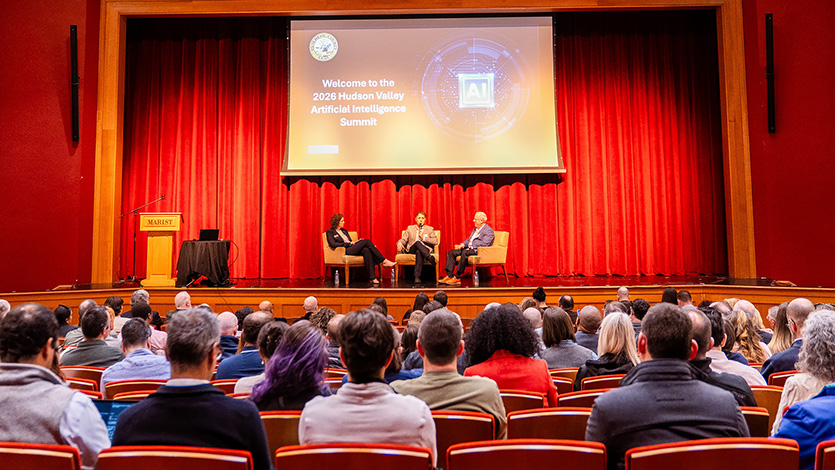
Diane Hart, Dr. Kevin Gaugler, and Mike Snodgrass of Google open the Hudson Valley Artificial Intelligence Summit in the Nelly Goletti Theatre. Photo by Nelson Echeverria/Marist University.
April 21, 2026 — Hundreds of industry leaders, innovators, and policy makers convened at Marist University for the annual Hudson Valley Artificial Intelligence Summit.
Co-hosted with Dutchess County Government, the summit occurred at a pivotal moment, just two days after Marist released its bold institutional AI strategy, making the event a showcase not only of regional collaboration, but of the University’s growing leadership in responsible and innovative AI use.
“At Marist, we believe the future of AI is not about choosing between technology and humanity—it’s about advancing both,” said President Kevin Weinman. “Grounded in our long-standing belief that technology should elevate human potential, this strategy reflects thoughtful input from faculty, staff, and students over the past year: it does not change who we are—it amplifies who we have always been.”
At the event, Weinman also spoke to the urgency of ethical leadership in AI, noting that Marist’s vision centers on producing graduates who don’t just know how to use AI, but also who are grounded enough to ask what it really should be used for.
President Weinman speaks at the Hudson Valley AI Summit. Photo by Emily Portnov '29/Marist University.
“That question is exactly why we’re all here today,” he said. “It is why Marist does not wait for the future to arrive, we help build it.”
AI for the Public Good
The Summit’s morning session featured Dr. Kevin Gaugler, Assistant Dean and Professor in Marist’s School of Liberal Arts and co-chair of the Marist+AI Initiative, and Mike Snodgrass, AI Specialist at Google, in a wide-ranging conversation moderated by Diane Hart, Assistant Vice President for Special Projects and Innovation and co-chair of the Marist+AI Initiative.
“Technology is only as good as the humanity behind it,” Hart said, laying out a guiding principle that would echo throughout the day.
Gaugler noted that societies have always grappled with the implications of new technologies.
“Understanding AI is the only way we’ll be good citizens,” he said. “We’re not going to be able to function as a democracy, as a society, if we don’t have educated human beings who can question truth, identify deep fakes, and understand how these systems work.”
Snodgrass explained some of Google’s AI initiatives in healthcare delivery and accessibility, and noted the company’s internal benchmarks that determined whether a model is safe to release.
“You have to be deliberate about this,” he said. “The protocols have to be in place to make sure that you’re designing a system that is going to be safe, ethical, and responsible.”
Student Research Showcase
The event also gave students the opportunity to step outside the classroom and engage with a broader community around their research through the Student Showcase.
Nathaniel Pena '26 presents research at the Student Showcase. Photo by Nelson Echeverria/Marist University.
Among those presenting was cybersecurity major Nathaniel Pena '26. His team showcased their work building a cyber range, a simulation that allows students to practice both attacking and defending cyber systems in a realistic environment. They used AI as a technical assistant to troubleshoot, document, and help move the project along more quickly.
“Presenting at the conference was a great opportunity to explain our work to people outside our immediate field and see how they responded to it,” Nathaniel said.
His thinking on AI itself highlighted themes that ran throughout the day’s event.
“Going into a world with AI is both exciting and something I approach with caution,” he said. “I see it as something that will be essential to understand work alongside, rather than something that replaces human expertise.”
For Bryson Fritz '26, whose presentation dealt with campus security, the summit capped off his senior year.
“I came into Marist with almost no technical background, and I'm leaving feeling genuinely prepared to enter the workforce and apply what I've learned,” Bryson said. “The coursework strikes a strong balance between theory and hands-on practical work, which ensures that by the time you graduate, you're not just familiar with concepts but actually ready to apply them.”
Exchange of Ideas
Breakout sessions throughout the day explored topics ranging from AI ethics and workforce development to agentic AI and real-world use cases.
Industry leaders from organizations like Rubrik, MicroTheory Engineering, WMCHealth, and the state of New York joined Marist faculty for sessions designed to move from theory to practice.
From left to right: Dr. Eitel Lauría, Dr. Casimer DeCustatis, and Michael Evans of Rubrik during the “Agentic AI: Putting AI to Work for You” panel.
In the “Ethics in AI: Building a Better Future” session, Dr. Sasha Biro dealt with questions of not just how AI systems are designed and used, but what they are contributing to society.
“It’s not just what we’re doing with AI, what we’re creating with AI,” Biro said. “It’s how do we create a better society? How do we foster human flourishing?”
Meanwhile, in the “Agentic AI: Putting AI to Work for You” session Dr. Eitel Lauría traced the evolution of AI from large language models like Claude and ChatGPT to agentic systems that set out to accomplish a task.
At the same panel, Dr. Casimer DeCustatis was candid in relation to cybersecurity. He discussed how agentic AI challenges nearly every foundational principle in cybersecurity.
“Agentic systems are doing things for you, they’re not just answering questions,” DeCustatis said. “They’re attempting to reason, they are goal driven, and we have no transparency in that.”
He called for urgent attention within government regulations, oversight, and security that has not yet caught up with the technology.


